Philadelphia · West Philadelphia
A ten-block stretch of Baltimore Avenue in West Philadelphia has more Ethiopian restaurants than most American cities. The food is authentic, the prices are rational, and the algorithm notices what Center City misses.
The Corridor
Head west across the Schuylkill into West Philadelphia and find the stretch of Baltimore Avenue that runs from 42nd to 50th Streets. In that ten-block corridor there are more Ethiopian restaurants than most American cities have. **Abyssinia.** **Dahlak.** **Kaffa Crossings.** And several others that don't have websites, don't take reservations, and have been feeding Penn professors, Ethiopian diaspora families, and curious undergrads for decades.
The neighborhood around Baltimore Avenue absorbed significant Ethiopian and Eritrean immigration in the 1970s and 1980s, mostly families who migrated through the Port of Philadelphia and stayed. The storefronts they built on these blocks have been open ever since, refining their recipes in relative obscurity while Center City gentrified around them. The economics work like this: a full vegetarian combination for two runs under $40 in most of the corridor. Execution is consistently high. The algorithm notices what Center City misses.
Execution and Integrity
The scoring pattern here separated what matters from what sounds good. Execution is consistently high—the injera is reliable, the wot braises are deep and patient, the spice profiles are the real thing rather than dumbed-down for tourist taste buds. Context is where these restaurants genuinely out-score their Michelin-neighbor competition. They are Ethiopian food as Ethiopian food, not as global cuisine tasting room. A doro wat at Dahlak arrives in a clay vessel, still radiating heat, the berbere deep enough to feel like history. The tibs at Kaffa Crossings crackle in cast iron because that is how tibs taste when they are made correctly.
The injera itself is the baseline test. A restaurant that rushes the fermentation or outsources the baking is a restaurant that doesn't understand its own food. Every spot on this corridor makes injera in-house. The sour is present. The springiness is there. The texture separates the places that treat it as a plate from the places that treat it as the meal.
The Full Meal
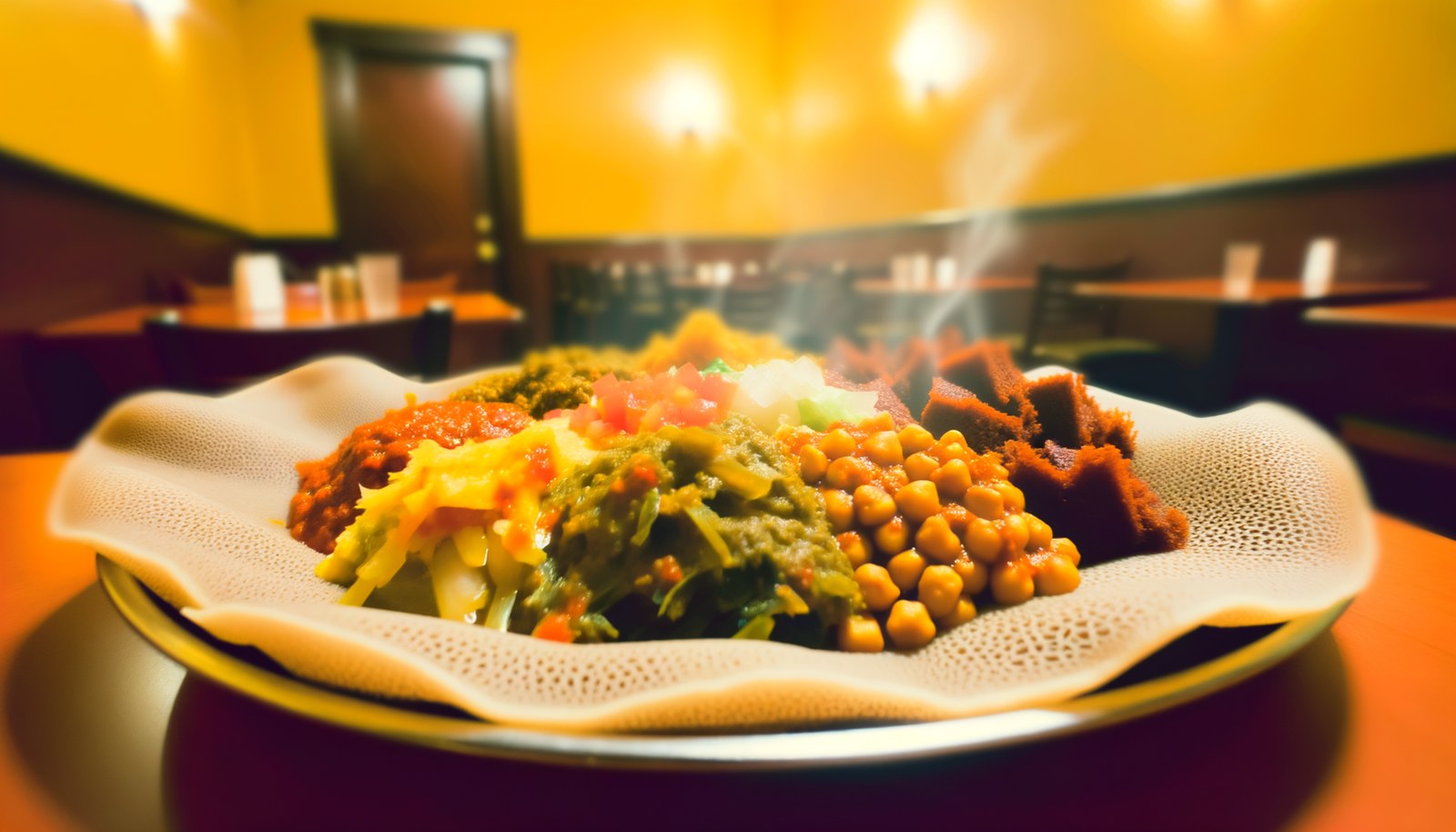
Order a combination platter and you will understand what the corridor is doing. A full spread arrives on a single sheet of injera—no plates, no division, communal by design. Kitfo, finely minced and niter kibbeh-rich, sits next to misir wot, the red lentils broken down to a paste. Tibs, cubed meat with onions and peppers, cooked down until it releases its own sauce. Shiro, the chickpea or bean paste that tastes like nothing in isolation and everything in context. Ayib, the fresh cheese that clears the palate. Tej, the honey wine that tastes like a secret.
The mathematics of the meal are impossible in most of the city. At **Dahlak** you will spend $37 for two people and leave full in a way that tasting menus do not accomplish. At **Kaffa Crossings** the vegetarian combinations run $28 to $32. The tibs plates at **Addis Red Sea** cost less than a sandwich from a chain five blocks south. The algorithm has run the per-ounce flavor calculation, and the result is geometric. These restaurants are not cheap. They are underpriced. There is a structural difference.
Context as Advantage
The corridor exists in a neighborhood that has been through cycles. The music venues that anchored West Philadelphia—the spaces where local talent moved—have contracted. The retail has shifted. But the Ethiopian restaurants have deepened. The multigenerational families who cook at these spots have watched their food become slightly more visible in the broader city's consciousness, and they have not changed their recipes to accommodate that visibility. That is the structural advantage. They are making food for their community first, for everyone else second.
This is different from Center City, where Ethiopian restaurants have become aspirational—where the food is plated with awareness that someone might post it online. On Baltimore Avenue the food arrives on injera because that is how it is served. The coffee ceremony at **Kaffa Crossings** lasts forty minutes because that is how the ceremony works, not because it is a photo opportunity. The room is what it is. The service is warm and functionally patient. The algorithm notices the difference. This is why these spots score higher on context than restaurants that spend more on design.
How to Eat Here
Go alone or go in pairs; the combination platters are built for one or two people to share. Order more than you think you need—the portions are generous, but the rhythm of the meal requires abundance. Most spots on the corridor are cash-preferred; a few take card. Most are open until 10 p.m. or later. Reservations are unnecessary but a call ahead on weekends is smart.
If you want comparison points, try the Vietnamese food on the Italian Market in South Philadelphia or the BYOB restaurants scattered through Fishtown. Both neighborhoods have their own rhythm and their own demographic relationship to the food. Baltimore Avenue in West Philadelphia is its own thing. It is Ethiopian food in a neighborhood where Ethiopian families have lived for forty years. That consistency shows.
The injera is reliable. The spice is real. The prices don't insult you. That's the entire story.
A corridor that has been here longer than most people noticed it doesn't change its recipes to get noticed now.
We test dishes so you don't have to. No spam — just the best food, neighborhood by neighborhood.