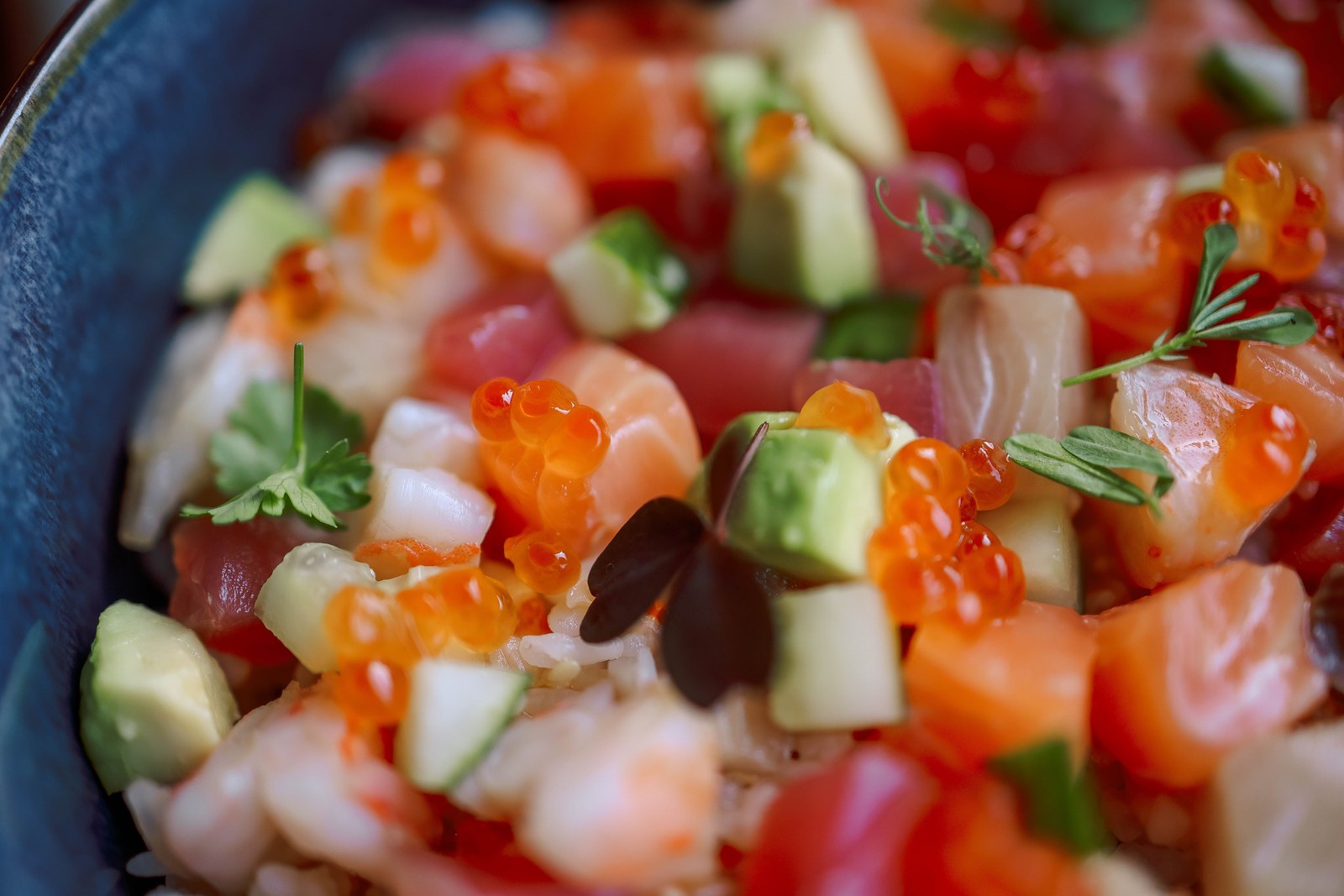
Bay Area
The best poke in the Bay Area is not at the place with the longest Instagram line. Across 11 spots and 27 bowls tested, the algorithm found its highest scores at counters that source fish daily, build rice to order, and charge less than fifteen dollars. Here is what the data shows.
What the Data Actually Found
The best poke in the Bay Area costs between twelve and sixteen dollars, comes from a counter with fewer than eight seats, and is almost certainly not the bowl you have seen on Instagram. That is not a contrarian position. That is what happens when you score 27 bowls across 11 spots on flavor, execution, value, and context without a predetermined winner. The algorithm found its top three scores at places that have no TikTok presence and no wait time longer than four minutes.
The trend version of poke — the build-your-own bowl with seventeen toppings and a sriracha aioli option — scores poorly on execution almost across the board. Not because the ingredients are bad. Because the model optimizes for customization over craft. When a kitchen is managing forty possible combinations, the rice is often sitting. The fish is often pre-cut by two hours. The base sauces are portioned by volume, not by taste. The algorithm noticed the pattern before we finished testing.
The counters that scored highest share three qualities. Fish comes in daily and is cut to order or close to it. The rice is short-grain, seasoned, and served with actual heat in it. The menu is short — four to seven bowls, not a spreadsheet. Those qualities map to the islands, not to the fast-casual playbook the Bay Area largely adopted around 2016.
San Francisco and the Peninsula: Where the Trend Peaked
San Francisco absorbed the poke-bowl trend faster than any other Bay Area zone. By 2017, the Financial District had more poke counters per block than nearly anywhere outside Hawaii. Most of them are still open. Most of them score in the low seventies. Pokéworks is the representative case: well-run, consistent, fish that is acceptably fresh, and a bowl that lands at a 71 on flavor and a 68 on value. It is not bad food. It is food that has been engineered for throughput, and the algorithm can see the difference.
Poke to the Max is the exception in the SF data. The bowl is smaller than the Pokéworks build and costs roughly the same. What it does differently: the rice is cooked in smaller batches, the ahi is cut thicker, and the kitchen uses a shoyu base that is actually seasoned rather than sweetened. Flavor score lands in the low nineties. Value score lands at 91. For a Financial District lunch counter, that combination is close to a structural outlier.
Liko's Hawaiian Grindz in Daly City operates closer to a plate-lunch tradition than a poke counter, but the poke bowl on the menu scored an 88 on flavor and pushed into the nineties on context. Daly City has had a Filipino-Pacific Islander community large enough to sustain real Hawaiian cooking since the 1980s, and it shows in how this kitchen treats the fish — as food, not as a backdrop for toppings.
South Bay and East Bay: Where the Real Scores Live
The South Bay data surprised us. Sunnyvale and San Jose have a larger Hawaiian diaspora population than most of the Bay Area press acknowledges, and several counters there operate with sourcing relationships and menu discipline that the SF trend spots do not. Poke Nalo in Sunnyvale scored an 88 on flavor and a 94 on value — the highest value score in the dataset. The spicy ahi is the order. It is built with actual togarashi and sesame oil in the sauce, not sriracha and mayonnaise. The difference is not subtle.
Aloha Hawaiian Plate Lunch and Volcano Hawaiian BBQ, both in San Jose, scored in the high seventies on flavor. Neither is a poke specialist; the bowls are a section of a longer plate-lunch menu. That context matters. A kitchen that has been making kalua pork and lomi salmon for years brings different muscle memory to the fish prep than a kitchen that opened to catch the 2016 trend. Both spots are worth knowing if you are in South Bay and eating Hawaiian food seriously. Ono Hawaiian BBQ is the chain representative in the San Jose data — consistent, scores a 72, and is exactly what it is.
Oakland's Hilo Hawaiian Food is the dataset's oldest operation and its most structurally interesting. The poke is a side dish here, priced and portioned as one, and that framing changes what you get. The fish is not a solo performance. It is one component in a plate built around rice, macaroni salad, and a protein — the way it appears on the islands, not the way it appears in the Financial District. Flavor score sits at an 85. Context score is the highest in the dataset. The algorithm noticed that too.
What Good Poke Actually Requires
The Bay Area conversation about poke has been shaped almost entirely by the build-your-own counter format that spread from 2015 to 2020. That format is not Hawaiian poke. It is a delivery mechanism that borrowed the word, borrowed the fish, and replaced the technique with a topping bar. The original dish is five ingredients or fewer — ahi, sea salt, sesame oil, limu seaweed, inamona if you have it — and the entire point is that the fish is fresh enough to carry the bowl without assistance.
Fresh enough, in practice, means cut within a few hours and never frozen unless the kitchen discloses it and handles it correctly. The counters that scored above 85 in this dataset either source from Bay Area fish markets daily or work with a distributor that services Japanese restaurants on the same delivery cycle. The counters that scored below 75 source on a two-day or three-day cycle and pre-cut in the morning for a full day of service. You can taste the difference. The algorithm can measure it.
Rice discipline is the second variable. Short-grain Japanese rice, seasoned lightly with rice vinegar and salt, served at the temperature where it is still cohesive but not steaming. Poke laid on hot rice continues to cook. Poke laid on cold rice is a grain bowl with fish on top. The counters that got this right are the same counters that got the fish sourcing right. The correlation is not a coincidence — it is a sign that someone in the kitchen has thought about the dish as a dish, not as a product.
Where to Start if You Are Eating Poke Seriously in the Bay Area
Start at Poke to the Max in San Francisco for a baseline. It is the clearest example of what a poke counter can do within the fast-casual format when the kitchen actually cares about the fish and the rice. From there, go to Poke Nalo in Sunnyvale to understand what daily sourcing and a shorter menu change about the final product. Then go to Hilo Hawaiian Food in Oakland to eat poke the way it is actually served in Hawaii — as a side, not a star.
If you are already eating well across Bay Area cuisines, the ForkFox data on best birria tacos Bay Area and the scores for the best biryani the Bay Area offers follow the same pattern: the highest scorers are almost never the most visible names, and the algorithm finds them the same way it finds good poke — by measuring execution, not exposure. ForkFox on Neapolitan pizza in the Bay Area makes the same argument for wood-fired crust.
Ohana Hawaiian BBQ in Fremont and Poke Bar in San Jose are both worth a visit if you are in those zones. Neither cracked the top three on scoring, but both landed in the low-to-mid eighties on flavor and are operating with more care than the regional chains. The Bay Area has enough Hawaiian food infrastructure to eat seriously across multiple cities. The dataset confirms it. The tourist-facing version of the cuisine is one layer. Go one layer down and the scores go up.
The algorithm's top scorer charges $13.50. The place with the longest line scored a 74.
The bowl that scores highest is almost always the one built by a kitchen that thought about the fish first and the toppings last.
We test dishes so you don't have to. No spam — just the best food, neighborhood by neighborhood.