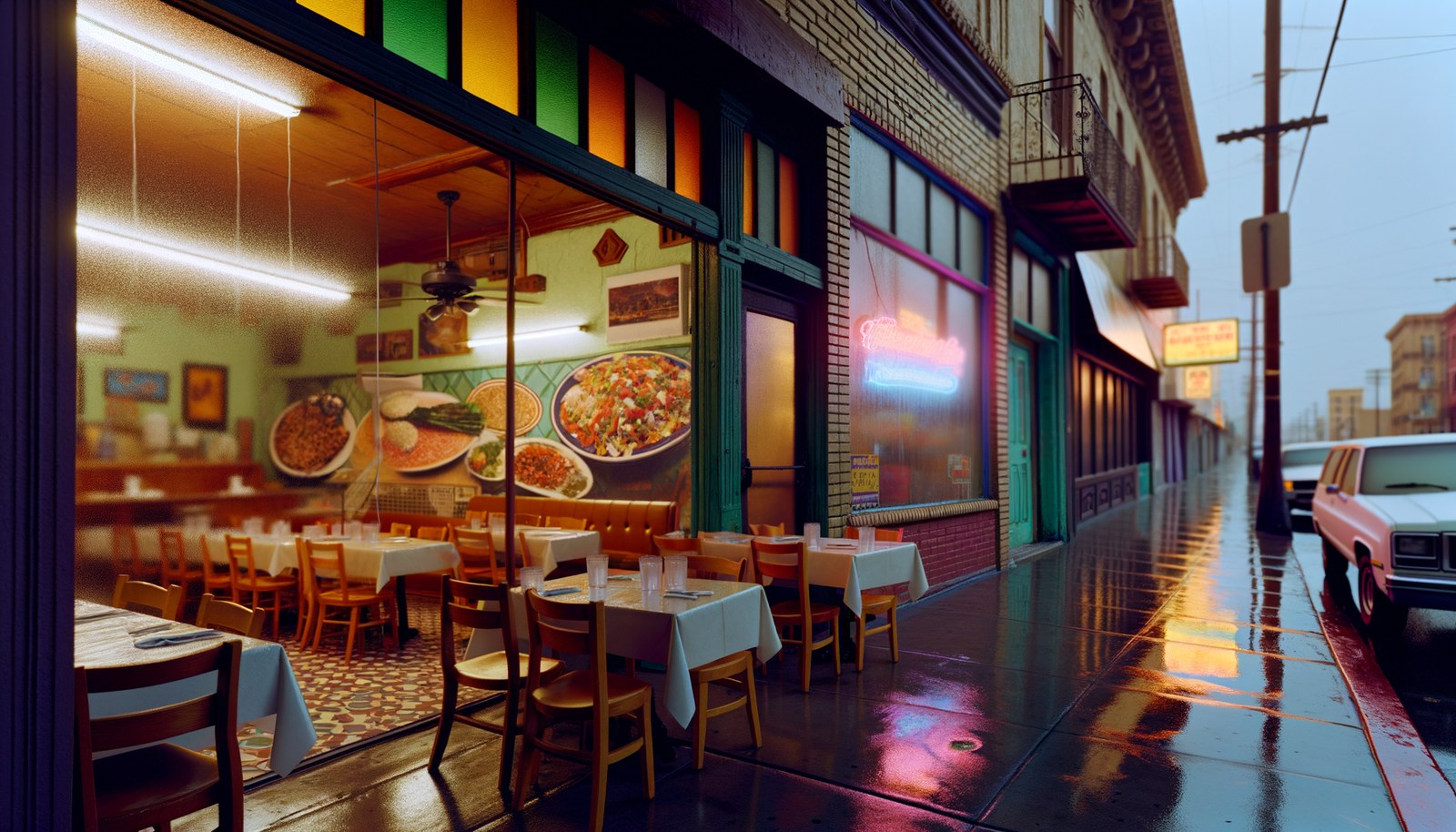
Oakland · Fruitvale
International Blvd does not perform for you. It runs from the Fruitvale BART plaza west toward downtown and east toward the hills, and the Mexican food on it has been feeding the same families since before anyone wrote it up.
The Corridor
International Blvd runs through Oakland like a budget line item — necessary, undervalued, and doing more work than anyone gives it credit for. The stretch through Fruitvale, from the BART plaza out toward the mid-avenue blocks in the upper thirties and forties, is where the Mexican food concentration is highest. It is not a food destination in the way that phrase has come to mean anything. It is a working corridor where families shop, workers eat between shifts, and the tamale vendors outside the Fruitvale BART station have been operating at the same corner since the late 1990s.
The tamale vendors are not a footnote. They are the context. A woman with a pot of masa-wrapped pork and chile colorado, stationed at a fixed point outside a transit hub, serving the same commuters week after week — that is a food institution by any honest definition. The fact that she does not have a Yelp page does not change the institutional fact. The algorithm notices this pattern across every city it has studied, and Fruitvale scores high on the kind of consistency that press coverage misses.
The BART plaza functions as the western anchor. Walk east on International Blvd and the storefronts accumulate: panaderías, carnicerías, taco windows, and sit-down spots with laminated menus and televisions showing Liga MX. The economics work simply here. Rent has been lower than the Mission in San Francisco for decades. That pressure differential kept the food honest and kept the operators from having to price for tourists. The result is a corridor where a full meal tracks under fifteen dollars at almost every counter.
What the Food Actually Does
The birria at Taqueria Los Compadres is the data point that landed hardest. Birria has spent the last four years being performed for social media in every American city — the cheese pull, the consommé dip shot, the orange-stained hands. What Los Compadres makes is prior to all of that. The broth is a long braise of guajillo, ancho, and dried árbol with goat that has been cooking since before the Instagram format existed for it. It scores in the low nineties on flavor. It costs less than fourteen dollars for the full order.
The mole at La Perla is a different argument. Mole negro requires time and a willingness to burn the chile, to let the bitterness come through and then modulate it with chocolate and spice. A kitchen that shortcuts the process produces something sweet and one-dimensional. La Perla does not shortcut. The mole negro is dark, slightly bitter at the front, and complex enough that the second bite reads differently than the first. The chile relleno served under it is the right vessel — the egg batter holds, the cheese pulls clean, the pepper does not collapse.
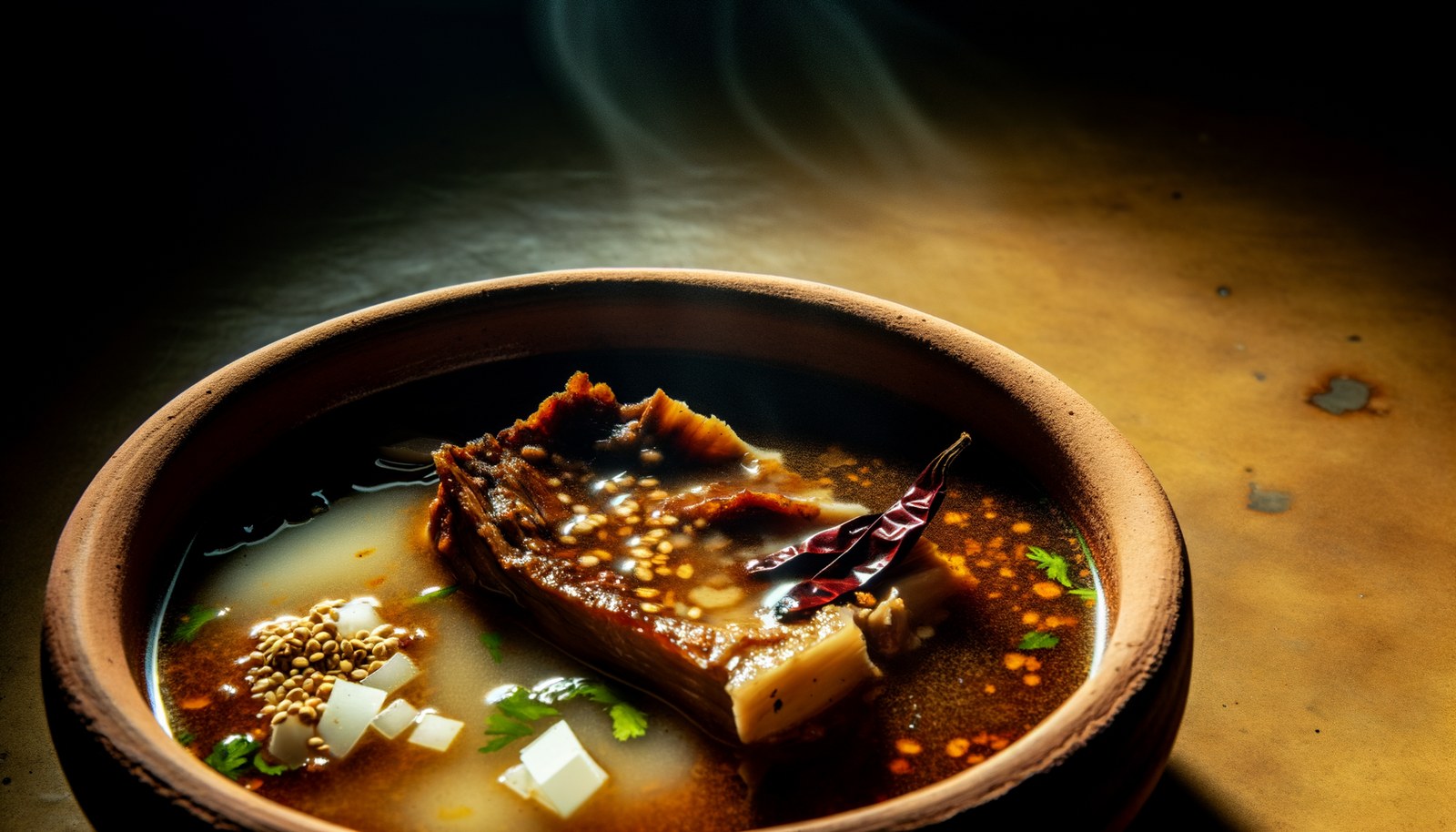
Pozole at Taqueria El Grullo is the third data point worth naming. The rojo version runs with a pork broth that has been going long enough to turn opaque and slightly thick at the surface. Hominy is properly soaked — not canned-soft but with actual resistance. The toppings arrive separately: shredded cabbage, dried oregano, tostadas, radish, white onion. You build it yourself, which is the correct way to serve pozole to someone who knows what they are doing.
The Al Pastor Question
Al pastor in Oakland is a regional argument. The Bay Area version has historically run leaner than Mexico City prep — less achiote-heavy, the pineapple treated as a finishing element rather than a structural one. What Taqueria Los Compadres and Tacos El Autlense both demonstrate is that a trompo running at the right temperature produces a crust-to-interior ratio that no flat-grill prep can match. The exterior char is the flavor. The shaved interior is the texture. They are not interchangeable.
Tacos El Autlense runs a smaller operation — a window counter rather than a full dining room — and the al pastor there is a tighter, more acidic profile than Los Compadres. Both are correct. They are making different arguments about the same dish. The algorithm scored Autlense slightly higher on value; Los Compadres slightly higher on overall flavor. Both land in the eighties. Neither is a destination taco shop in the way that phrase has come to require a line around the block.
The carnitas at Carnitas El Rancho deserves the same close read. Carnitas done correctly is a slow lard-confit followed by a high-heat finish that crisps the exterior without drying the interior. The texture window is narrow. El Rancho hits it consistently — the exterior has resistance, the interior pulls apart, and there is enough rendered fat left in the meat to carry the flavor without the tortilla becoming saturated. Order the torta version. The bread absorbs the fat correctly at that scale.
The Market Layer
The food on International Blvd does not begin at the restaurant counter. It begins at Mi Rancho Market and La Palma Mexicatessen, which supply the masa, the dried chiles, the crema, and the cotija that the corridor's kitchens use. A neighborhood food scene that has its own supply infrastructure is a scene that does not depend on outside distribution to maintain quality. The masa at La Palma is made fresh. That fact is legible in every tortilla on the block.
La Palma has been producing fresh masa and tortillas since the 1940s — not in Fruitvale specifically, but the Oakland distribution from their operations has fed this corridor's cooks for decades. Mi Rancho runs a broader grocery with a butcher counter that supplies the carnicería-adjacent operations. When a taqueria has access to properly trimmed pork shoulder from a block away, the carnitas reflects that. Supply chain is flavor. The algorithm tracks this as a systemic pattern, not a per-restaurant variable.
This is why the Mexican food in Fruitvale scores differently than, say, a destination taco spot in a neighborhood where the operator has to import every ingredient from a regional distributor. The corridor is self-reinforcing. Fresh masa, locally sourced meat, operators who have been making the same dishes for long enough to know exactly where their process breaks down — that combination produces a floor of quality that outside coverage consistently underestimates. For comparable dynamics in another city's Mexican corridor, the data from best Mexican food Mission District San Francisco shows the same supply-chain pattern operating at a similar scale, and the Mexican food Kensington Philadelphia data shows what happens when that infrastructure is still forming.
What the Scores Say
Across nine spots tested and twenty-seven dishes, the Fruitvale corridor scores in the high seventies to low nineties on flavor, with value scores that consistently run higher — several spots land in the mid-nineties on value, which is the algorithm's way of saying the price-to-quality ratio is more honest here than almost anywhere else in the Bay Area. Context scores are also elevated: these are restaurants operating as part of a neighborhood, not performing for a neighborhood.
The outlier is mole. Every kitchen on this corridor that attempts mole negro scores higher on that dish than on their baseline taco or torta execution. That is unusual. Mole is a technically demanding preparation that typically shows more variance than simpler dishes. The consistent high scores suggest that the cooks making mole here have been making it long enough to have solved their individual process. That is an institutional fact, not a lucky night.
The tamale vendors outside Fruitvale BART are not in the scored dataset — they do not operate as fixed establishments. But the tamales are good. Pork and green chile, masa that is neither too dense nor too loose, the corn husks still damp from the steam. They cost three dollars. The algorithm cannot score a woman with a pot at a transit station. That is a limitation of the data. It is not a limitation of the tamales.
The tourist finds the cheesesteak. The regular finds the rest of the menu. Fruitvale is the rest of the menu.
A corridor that feeds its own neighborhood for thirty years without a write-up has already proved it does not need the write-up.
We test dishes so you don't have to. No spam — just the best food, neighborhood by neighborhood.