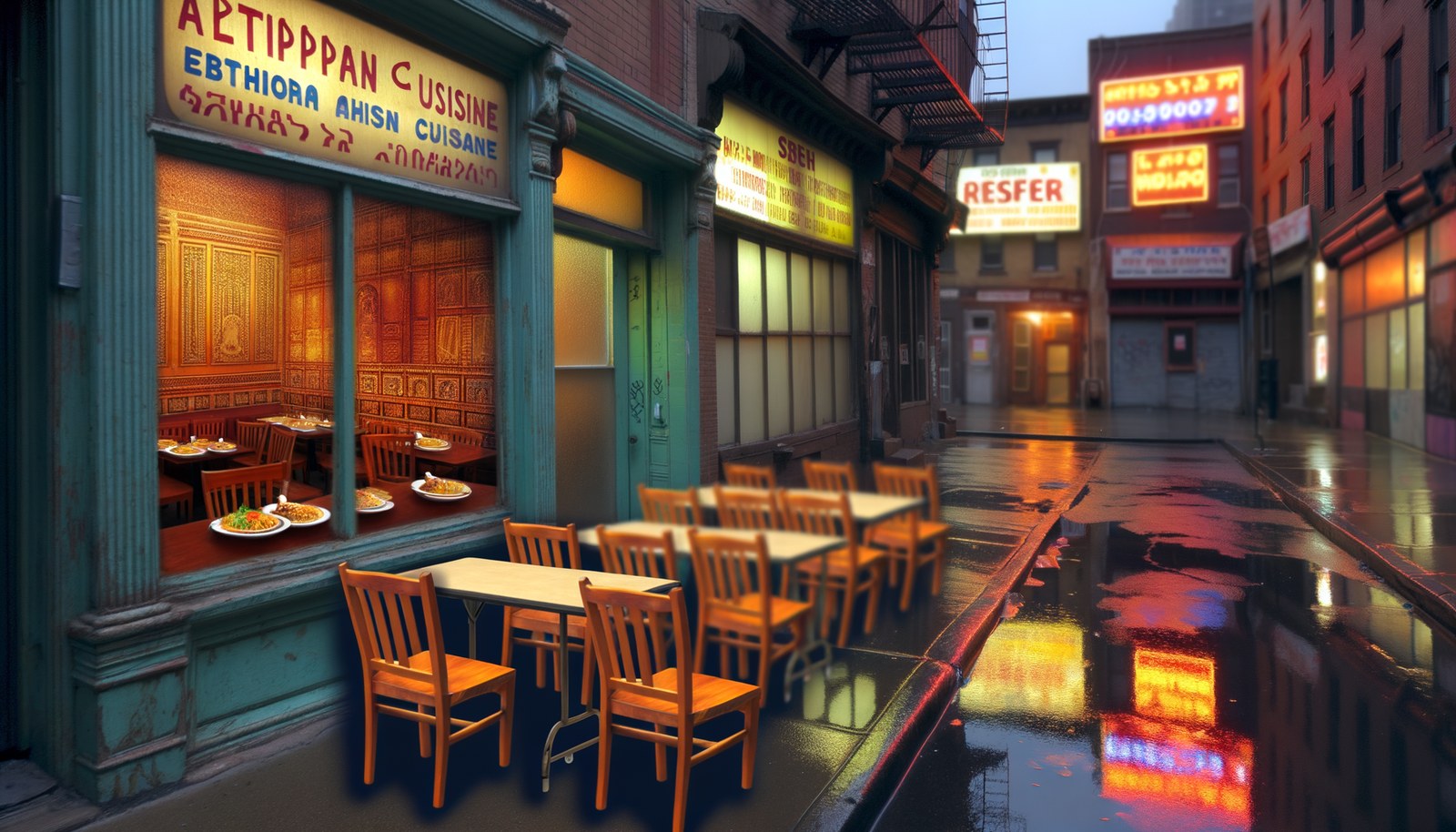
both · West Philly / Tenderloin
Baltimore Avenue and Larkin Street both built Ethiopian corridors out of diaspora economics and cheap commercial rent. The food is serious at both ends. The scoring splits in unexpected places.
The Two Corridors
West Philadelphia built its Ethiopian corridor in the 1980s and 1990s along the stretch of Baltimore Avenue that runs from 42nd to 50th Streets. Habesha families came through New York and D.C. first, then followed the rent westward into a neighborhood that had cheap commercial storefronts, a large university population that would eat anything interesting for under fifteen dollars, and very little competition from established cuisine clusters. The storefronts they opened have stayed. Abyssinia. Dahlak. Kaffa Crossings. And Queen of Sheba, which has been on Baltimore Ave long enough that its sign is sun-faded in the specific way that signals pre-Instagram permanence.
The Tenderloin built its Ethiopian and Eritrean corridor along Larkin Street and its adjacent blocks through a parallel logic: low commercial rent, a walkable residential density of East African immigrants, and proximity to the city's social services infrastructure, which kept the neighborhood affordable when Hayes Valley and Polk Gulch were not. Cafe Eritrea d'Afrique. Massawa. Bini's Kitchen. These are not the same restaurant. They are not trying to be. The Eritrean places on Larkin Street make the injera with a slightly tighter ferment than the Ethiopian places two blocks over, and the regulars who know the difference order accordingly.
The comparison matters because both corridors developed outside the city's food-media attention zone. West Philly does not appear in most Philadelphia restaurant guides. The Tenderloin appears in San Francisco guides mostly as a warning about the walk from the parking garage. The algorithm noticed both corridors because the scoring data does not care about the neighborhood's reputation. It cares about the wat.
The Injera Question
The injera is where the two corridors diverge first. Baltimore Avenue injera is made with more teff, fermented longer, and arrives with a sourness that functions as a flavor layer rather than just a vehicle for the stews. At Dahlak the fermentation is pushed far enough that first-time guests occasionally mistake it for a flaw. It is not a flaw. It is the correct product of a starter culture that has been maintained since the restaurant opened. The scoring pattern reflects this: execution scores at Dahlak run in the high eighties, driven partly by the bread itself.
Larkin Street injera is slightly thinner on average and the fermentation is shorter — not because the cooks are cutting corners, but because the Eritrean tradition that anchors Cafe Eritrea d'Afrique and Massawa uses a different ratio. The teff percentage is lower. The texture is more uniform. Whether this is better or worse is a question with no correct answer and several strong opinions from the regulars who eat at both corridors when they travel. The algorithm scores them on their own terms, not against each other.
Shiro is the diagnostic dish. A chickpea flour stew that takes technique to keep from going flat, it is the menu item that separates restaurants maintaining their recipes from restaurants that have started approximating them. At Abyssinia the shiro has the grainy, deeply spiced density of a dish that is being made from a long-held base. At Bini's Kitchen in the Tenderloin it is looser, faster, calibrated for the lunch pace of the counter. Both are correct for what they are. The data shows it.
Tibs, Kitfo, and What Gets Ordered
Tibs is the order-test. Every Ethiopian restaurant serves it. Almost every one makes it differently enough that the tibs at Dahlak and the tibs at Massawa are distinguishable to anyone who has eaten both more than twice. West Philly tibs tends toward a longer braise at the table's pace — the berbere has time to work into the meat. Tenderloin tibs, especially at Bini's Kitchen, is faster and higher-heat, closer to a stir-fry than a braise. Neither is wrong. Both reflect the room they are being served in.
Kitfo is where Baltimore Avenue separates itself from most of the country. At Dahlak they serve it raw unless you ask otherwise and the leb leb (medium) and fully cooked versions are listed as accommodations rather than defaults. This is the correct position. Kitfo that has been cooked to well-done because the restaurant has decided the guests cannot be trusted is a different dish, and the scoring reflects the difference. The Tenderloin has fewer kitfo specialists; Aster, which sits at the more polished edge of the SF Ethiopian scene, does a version that scores well but is a different product category — it is kitfo for a dining room that expects presentation.
Tej, the honey wine, is available at several spots on both corridors but inconsistently. At Queen of Sheba in West Philly it is poured in the clay-bottomed flask that functions as both vessel and conversation piece. At Cafe Eritrea d'Afrique in the Tenderloin the tej is sometimes out of stock and the server will tell you without apology, which is the correct response. A restaurant that is out of something because it runs out is a restaurant with regulars. The algorithm notices.
The Economics of Staying
The West Philly corridor runs on BYOB. This is not a novelty or a workaround — it is the economic structure that makes the price point work and keeps the tables full on Tuesday nights. A full vegetarian combo for two at Abyssinia, with injera, shiro, misir wot, and gomen, tracks under forty dollars before you factor in the bottle of wine you brought from the corner shop on 43rd Street. This is the economics of a neighborhood restaurant that has decided it does not need a liquor license to keep the lights on. The model has worked for thirty years. For more on how this pattern plays out elsewhere, see our piece on Ethiopian food in West Philadelphia.
The Tenderloin corridor runs on density and foot traffic. Larkin Street has enough residential density — working families, long-term renters, a significant East African community concentrated between Geary and Market — that the restaurants do not depend on destination diners. Zeni is full on a Wednesday because people who live within four blocks are eating there, not because someone read about it. The scoring consequence is that context scores are high: these restaurants are operating in their intended environment, not performing for an outside audience.
The comparison to Vietnamese food on the same corridors is instructive. The data we collected for Vietnamese food Philadelphia vs San Francisco showed a similar pattern: the corridors built on immigrant residential density outperform corridors built on food-tourist footfall, and they outperform on the metrics that matter most — flavor consistency, value, and the willingness to maintain a recipe rather than adjust it for the median Yelp reviewer. Ethiopian food on both coasts follows the same logic. The room full of regulars is the quality signal.
What the Data Shows
Across the nine spots tested, the West Philly corridor scores higher on execution and value. The injera is more consistent, the stew depth is deeper on average, and the BYOB structure keeps the total check in a range that rewards repeat visits. Baltimore Avenue from 42nd to 50th is a corridor where the restaurants have had decades to get the recipe right and no financial incentive to change it for outside tastes.
The Tenderloin corridor scores higher on context. The Eritrean influence gives the food a slightly different technical profile — tighter injera, faster tibs, a different fermentation tradition — and the neighborhood density means the restaurants are genuinely feeding their community rather than performing for it. Bini's Kitchen and Cafe Eritrea d'Afrique score in the high eighties on flavor. Massawa's value scores are among the strongest in the entire San Francisco data set. For a deeper look at how the Bay Area compares on a similar corridor, see ForkFox on Temescal's Ethiopian cluster, where Oakland's version of the same dynamic plays out with even less outside attention.
The principle that connects both corridors is older than the scoring system. A restaurant that has been feeding the same neighborhood for twenty-five years without a website is not operating on hope. It is operating on a proven product. The tourists who find Baltimore Avenue and Larkin Street do not make these restaurants; they just get lucky.
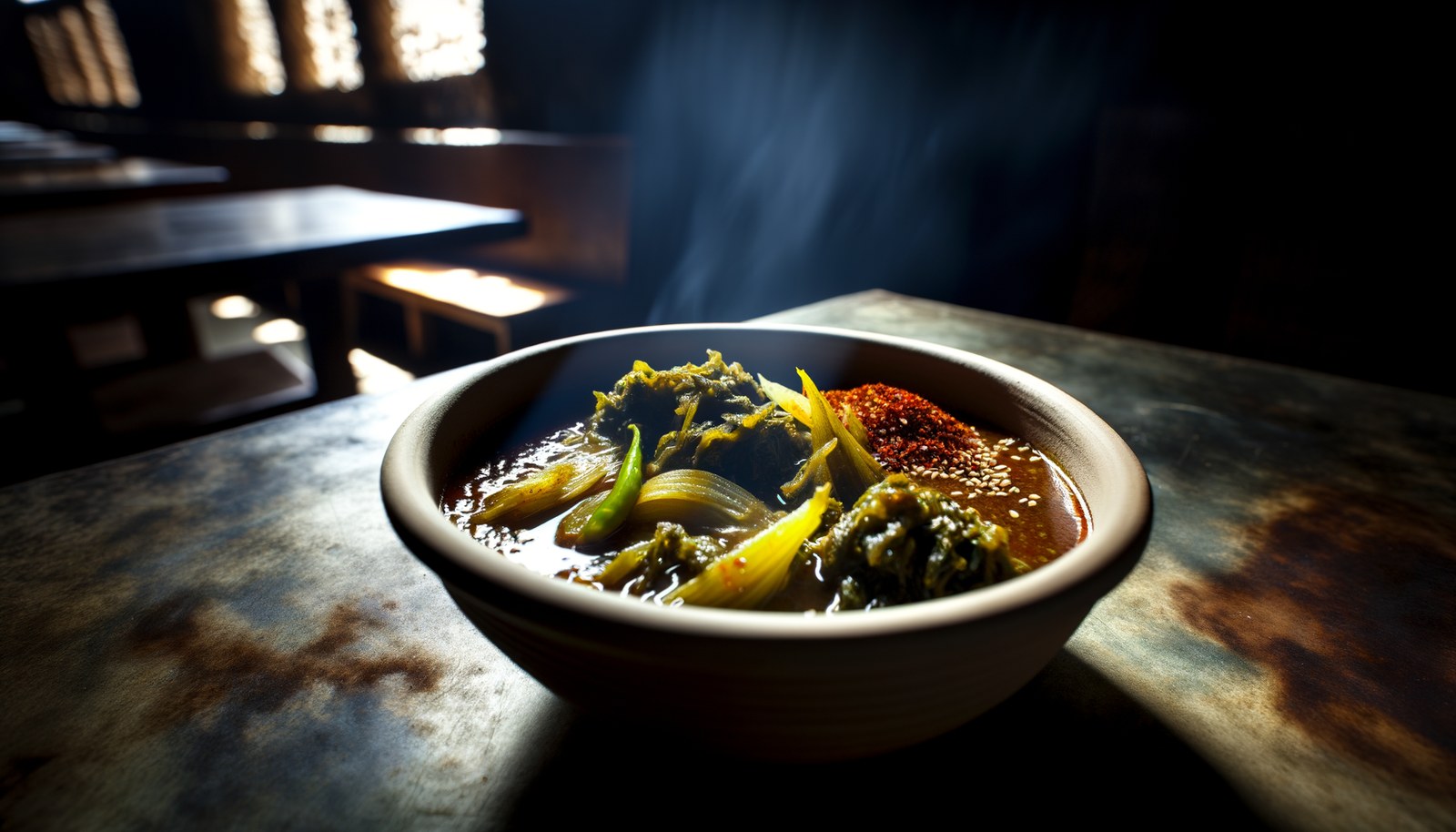
The injera is the baseline. Everything else is a position statement.
The restaurant that has been feeding the same block for twenty-five years is not waiting for a review; it already knows it works.
We test dishes so you don't have to. No spam — just the best food, neighborhood by neighborhood.