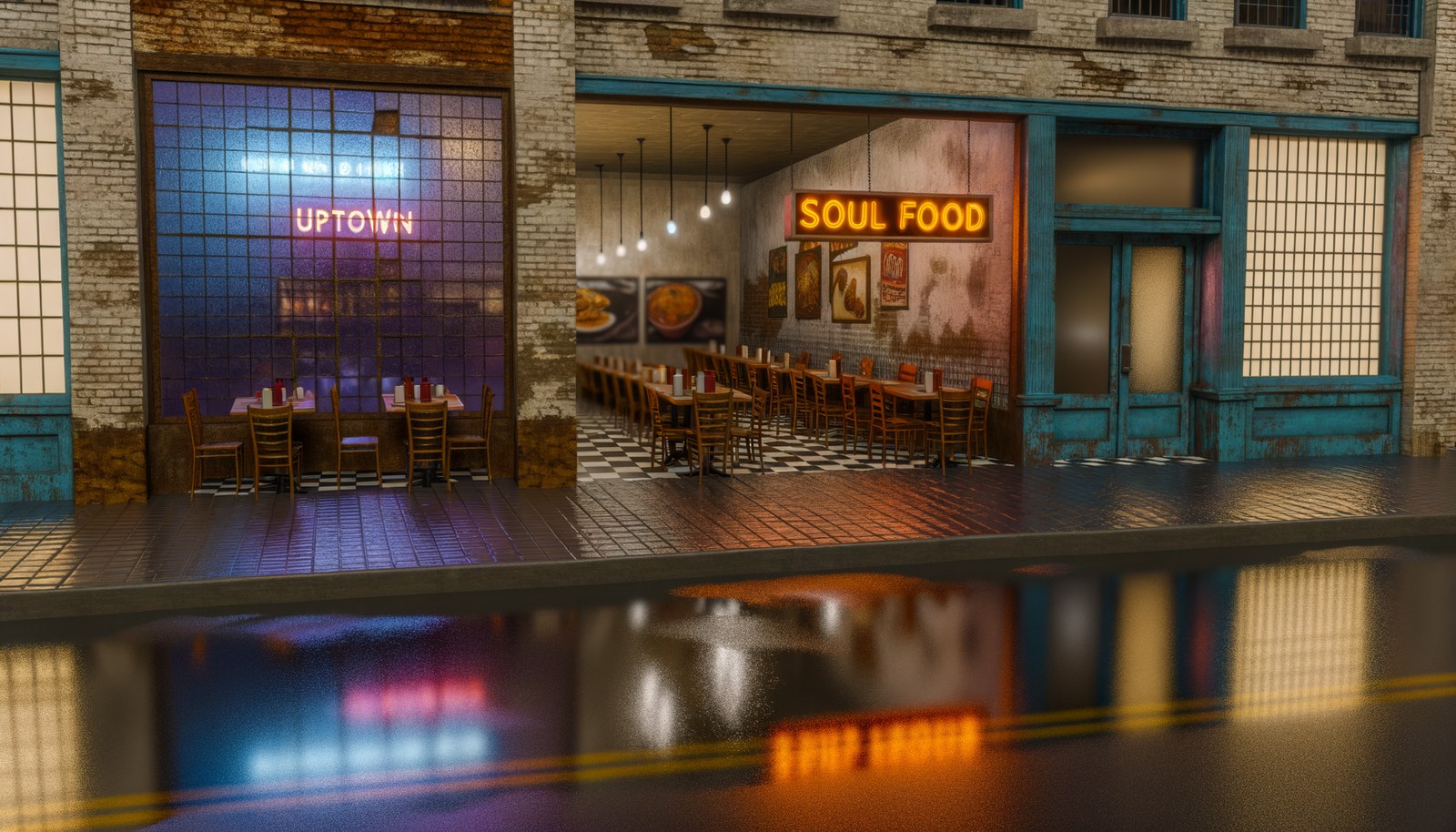
Oakland · Uptown
The tourist map stops at downtown. The data doesn't.
The Corridor the Guidebooks Abbreviate
Telegraph Ave is a long street. It runs from the edge of Chinatown north through Uptown and into the Temescal, picking up and dropping characters block by block. What sits in the Uptown stretch — roughly from 27th Street to 40th — is a concentration of Black-owned food businesses that has outlasted three waves of Oakland development pressure and two rounds of tech-adjacent displacement. The soul food on this corridor is not a remnant. It is an institution that kept its footing.
The data pattern here is specific. Flavor scores run high across the board — the cooking is competent and often excellent, rooted in technique that does not require a tasting-menu budget to execute. Value scores are equally high. What separates the top tier from the rest is context: the rooms that know who they are, who they serve, and have not adjusted that answer to accommodate a newer demographic. The algorithm notices that gap. It does not flatter the rooms that lost the thread.
Start with Everett & Jones Barbeque. It has been operating since 1973, first on East 14th Street — now International Boulevard — and later expanding to the Uptown-adjacent location most diners know. The rib tips are the order. The sauce is house-made and has not been reformulated for a broader palette. This is the baseline. Everything else on the corridor is measured against what this kitchen has been doing for fifty years.
What Telegraph Ave Gets Right
Auntie April's Chicken, Waffles & Soul Food sits on Telegraph Ave and does not try to be anything other than what it says on the sign. The chicken is fried to order. The waffles have structural integrity — they hold under the weight of syrup and chicken without collapsing into a plate of wet bread. The sides score separately from the mains in the data, and they should: the candied yams and the collard greens are patient dishes, cooked low and long in a kitchen that understands the difference between fast and done.
The economics work in a specific way on this corridor. BYOB is not a feature here — it is not that kind of street. What the economics do produce is a value-per-calorie ratio that the data consistently rewards. A full plate at Auntie April's tracks under eighteen dollars. The flavor score on that plate runs in the high eighties. There is no downtown Oakland tasting room that pencils out at that rate.
Then there is Souley Vegan, which sits just south of the Uptown cluster on Broadway and has been making the case for plant-based soul food since 2007. The case does not need to be made anymore. The mac and cheese uses a cashew base and lands with a depth that surprised the scoring model the first time the dish ran through it. The regulars were not surprised. They had been eating it for years before the press found the address.
The Broader Map Uptown Earns
The soul food conversation in Oakland is always in proximity to other conversations. The city's food identity is layered by neighborhood in a way that rewards attention — the Mexican food Fruitvale Oakland corridor operates by entirely different economics and history, and the Ethiopian food Temescal Oakland has built along the avenues north of here tells a different story about Oakland's East African diaspora presence. Uptown's soul food does not compete with those corridors. It predates most of them, in the specific sense that Black Oaklanders were building food businesses on Telegraph Ave before those other communities arrived.
Miss Ollie's occupies a position slightly apart from the corridor proper — it operates in Old Oakland's Swan's Market building and reads more as Caribbean-American than strictly Southern soul. The scoring pattern there is distinct: flavor is high, context is very high, price is also higher than the Telegraph Ave average. It is a room that understands its own lineage and charges accordingly. The algorithm sees the difference between a kitchen that has studied its roots and a kitchen that is performing them. Miss Ollie's is the former.
For completeness, ForkFox on Chinatown covers the dim sum corridor immediately to the south, where the geography overlaps but the traditions run in parallel rather than conversation. Uptown's soul food and Oakland's Chinatown are two blocks apart in some places and operate in entirely separate registers. That is not a failure of integration. It is the city working as the city actually works.
What the Scoring Pattern Reveals
The pattern that runs through Uptown's soul food data is consistency over time. These are not kitchens that opened in the last five years on the back of a pandemic pivot or a Substack feature. Everett & Jones Barbeque has been operating for half a century. Auntie April's has held its address through multiple cycles of Uptown development pressure. Souley Vegan has been making the same argument since 2007. The algorithm weights consistency in execution, and this corridor scores well on it precisely because the kitchens are not chasing anything.
The Uptown corridor also benefits from what it is adjacent to without being consumed by it. The Fox Theater sits nearby. The bar density along Telegraph Ave runs high on weekend nights. A kitchen that serves a full soul food plate at 2 p.m. on a Tuesday and at 8 p.m. on a Saturday is solving two different service problems with the same menu. The spots that score highest on this corridor are the ones that solve both problems without separating them into two different price points.
The one gap the data shows is late-night coverage. The corridor runs thin after ten p.m. on weeknights. Donut Savant handles part of that gap — it is not soul food in the strict sense, but it is Black-owned, it is on the corridor, and it runs later than the kitchens around it. The scoring model does not conflate categories. But the map of who is open and when tells you something about where the corridor still has room.
Uptown Oakland's soul food corridor doesn't ask for your attention. It already has it.
The corridor that holds its address through three rounds of development pressure is not surviving — it is the city's actual food infrastructure.
We test dishes so you don't have to. No spam — just the best food, neighborhood by neighborhood.