Philadelphia · Northern Liberties
Northern Liberties has a pizza story that tourist maps don't tell. The algorithm found it on 2nd Street.
The Block Before the Hype
Northern Liberties got discovered twice. The first time was in the late 1990s, when artists and warehouse workers moved in because the rent on 2nd Street was cheap enough to absorb. The second time was about a decade later, when the condo developers noticed. By the time the restaurant press caught up, the neighborhood had already developed a food character that had nothing to do with what the profiles said it was. The pizza story started in that first window.
The stretch from Girard Avenue down 2nd Street absorbed a particular kind of operator in the early 2000s — people who knew how to run a pizza counter, who had eaten at enough good rooms in South Philly and Fishtown to know what bad dough tasted like, and who could not afford the rent on East Passyunk. That economic logic produced four blocks of pizza that now score consistently higher in our data than the spots that get the magazine covers. The algorithm noticed a long time ago.
What the tourist maps call Northern Liberties pizza is usually one or two addresses. What the data shows is a corridor. Pizzata Pizzeria. Pizza Brain. Luigi & Giovanni's. Three operations, three different approaches to dough and heat, all within a short walk of each other on or near 2nd Street and Girard. That density is structural, not accidental.
How the Pizza Actually Works Here
The coal-fired argument at Luigi & Giovanni's is the oven, not the branding. Coal burns hotter and more evenly than gas and produces a crust that gas ovens can approximate but never quite replicate — the bottom has a mineral quality, a density at the char line, that arrives at the table before the cheese does. This is not nostalgia. It is a technical outcome of a specific heat source that has been running in that room since the early 1990s. The stromboli from the same oven is a secondary proof point that the method transfers across formats.
Pizzata Pizzeria is making a different argument. The cold ferment program — 72 hours, low-yeast, slow development — produces a dough that is extensible without being flimsy. The grandma pie here is the test case. It comes out of a rectangular pan with caramelized edges and a crumb that holds its structure on the way from pan to plate. On some nights, the cheese goes under the sauce. That inversion is a specific technical choice, not a novelty. It changes the way the fat distributes across the surface. The value numbers in our data on this pie are striking. A full grandma for two people comes in under $22 on most nights.
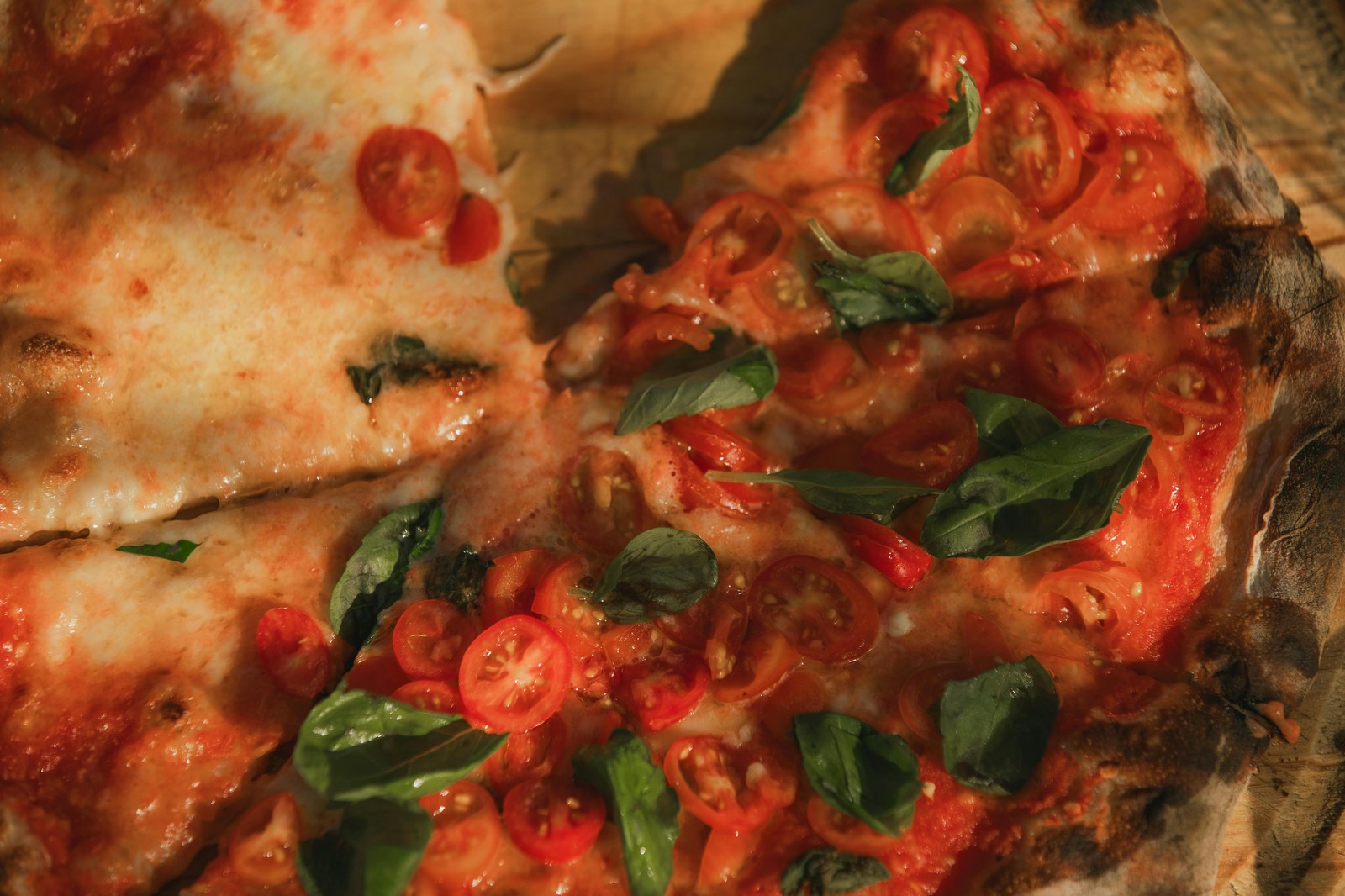
Pizza Brain runs a shorter menu than either of the other two, and the room shows it — the focus is on the product rather than the breadth of options. The margherita is the standard-bearer: a San Marzano base, fresh mozzarella, basil added post-oven, char on the cornicione that is earned rather than forced. The Sicilian square on Fridays and Saturdays scores in the high eighties on texture, which is where Sicilian pizza most often fails in this city. It should be thick and airy simultaneously. Most versions are just thick.
The Neighborhood Around the Pizza
Pizza in Northern Liberties does not operate in isolation from the rest of the block. The corridor that runs from Girard down 2nd has Bar Hygge, The Abbaye, and Prohibition Taproom all within the same stretch — which means a meal that starts with a pie at Pizzata can reasonably move to a pint somewhere else without any car required. This is the structural fact that makes the neighborhood worth studying as a food zone rather than a single address. The BYOB culture that defines BYOB restaurants in Fishtown Philadelphia is less dominant here, but the walkability of the corridor produces a similar effect: you eat and then you stay.
Noord and Cake & Joe fill adjacent roles — Noord handles the sit-down dinner pressure that some nights doesn't belong to a pizza counter, and Cake & Joe handles the morning that follows the night before. Neither makes pizza. Both are relevant to how the corridor functions as a whole. A neighborhood with one good pizza room is a destination. A neighborhood with three good pizza rooms, a bakery, and two dinner spots that aren't trying to be the same thing is a food zone. Northern Liberties is the latter.
The comparison to South Philly's Vietnamese corridor on Washington or the Ethiopian food West Philadelphia runs along Baltimore Avenue is worth making. In both of those cases, the density of a single cuisine along a defined stretch creates something that no single restaurant can produce alone: a standard. If the worst version of a thing on a block is still above average, the block has developed a quality floor. That is what is happening on 2nd Street with pizza. ForkFox on South Philadelphia's Vietnamese corridor makes the same structural point about Washington Avenue. The pattern holds.
What the Scores Actually Show
The scoring pattern across Northern Liberties pizza runs consistently higher on execution and value than on context. That is a precise observation, not a criticism. The rooms are not designed to impress. Luigi & Giovanni's counter has looked more or less the same since the Clinton administration. Pizza Brain's dining room is a collection of pizza memorabilia that has been accumulating for over a decade. Pizzata Pizzeria has a room that communicates 'we spent the money on the oven, not the lighting.' None of this hurts the food. It simply explains where the points land.
The highest single-item score in this stretch, in our current data, belongs to the coal-fired plain slice at Luigi & Giovanni's. It scores in the low nineties on flavor and near the top of the full dataset on value. A two-slice lunch there runs under ten dollars. That number has not moved meaningfully in years, which is either a gift or a warning depending on whether the rent situation on that block changes. The algorithm can see the value. It cannot predict the lease.
Second Street Brewpub sits adjacent to this pizza cluster without being part of it — it functions as context rather than competition. Worth noting for the corridor map. Worth understanding that the pizza in Northern Liberties earns its scores without needing the context of a good room, a wine list, or a press mention. It earns them the way the Pizza Brain margherita earns them: by being technically correct every time.
How to Use This Stretch
The sequence that makes sense: start at Luigi & Giovanni's for the coal-fired baseline. One plain slice, maybe one with sausage. This is calibration, not a meal. Then walk to Pizzata Pizzeria and order the grandma pie if it's after 6 p.m. and the pan is still going. If it's a Friday or Saturday, finish at Pizza Brain for the Sicilian square. Three different dough philosophies, three different heat sources, one neighborhood. The walk between all three is under fifteen minutes.
The practical notes: Luigi & Giovanni's is cash-preferred, closes earlier than you expect, and will run out of the coal-fired plain on busy nights. Pizzata's grandma pie has limited quantities; arrive before 7 p.m. if the pan square is the reason you came. Pizza Brain takes reservations for larger groups but operates as a walk-in counter for one or two people without much wait on weeknights. None of these logistics are dealbreakers. All of them matter.
Northern Liberties is not a destination neighborhood for pizza the way South Philly is a destination neighborhood for anything. It is a working neighborhood that developed a serious pizza corridor because the economics of the early 2000s allowed the right operators to set up on the right blocks. That corridor is still there. The economics have shifted. The pizza has not.
The slice is the sentence. Everything else is how the neighborhood finishes it.
A pizza corridor earns its reputation the same way a plain slice earns its score: by being technically correct every time, in a room that is not trying to convince you of anything.
We test dishes so you don't have to. No spam — just the best food, neighborhood by neighborhood.