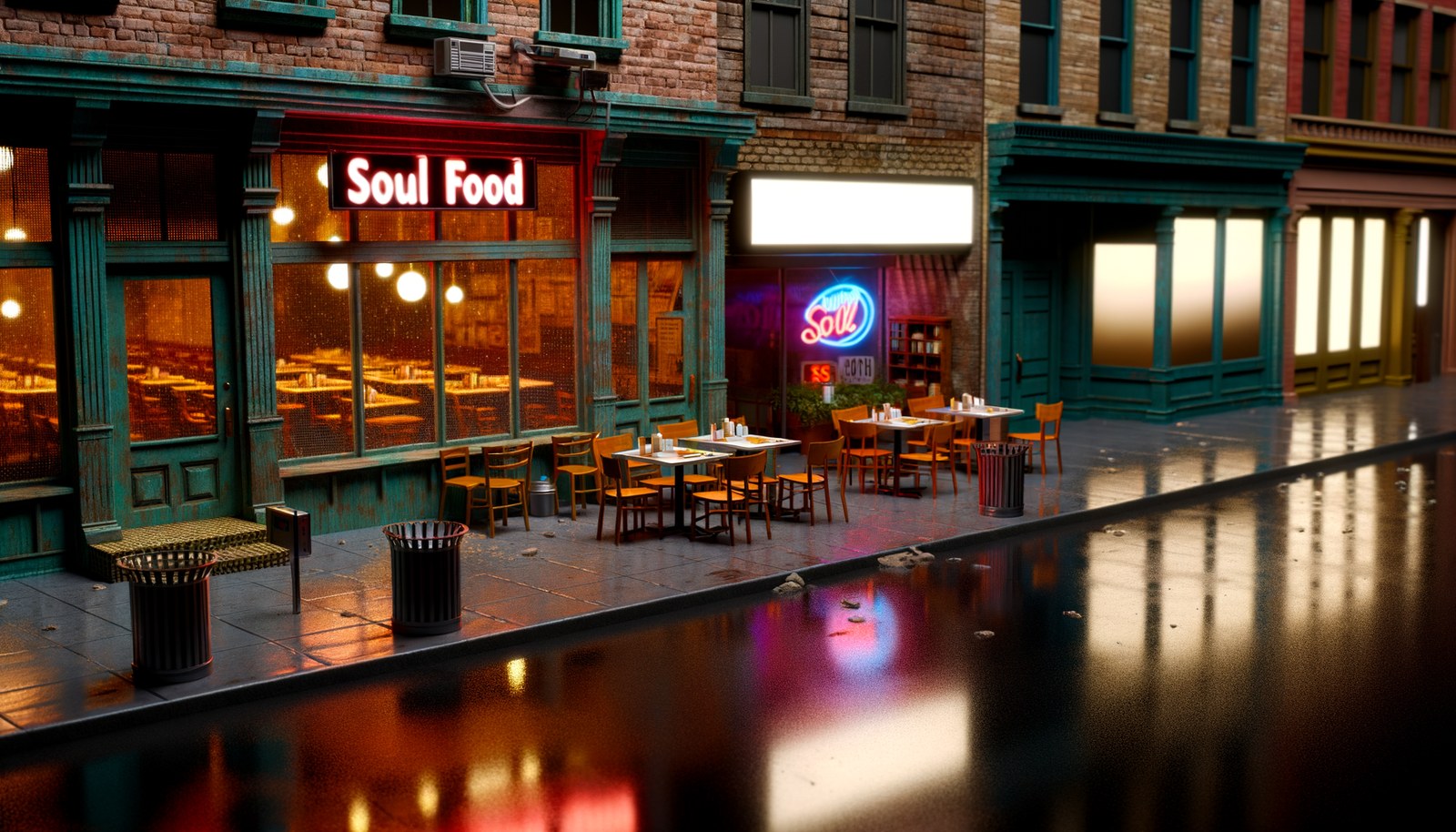
San Francisco · Bayview
The tourists don't come here. The data does.
What 3rd Street Is
There is a version of San Francisco food writing that treats Bayview as a place that is about to have a moment. The moment, depending on the article, has been arriving since approximately 2012. Bayview is not about to have a moment. Bayview has a food corridor. It has had one for thirty years. The difference between those two sentences is the difference between a city that understands its own geography and one that only reads about it.
3rd Street runs south from Caltrain through the Dogpatch and into Bayview proper, and the stretch between Cesar Chavez and Palou is where the soul food sits. Not scattered, not occasional — concentrated, with the kind of density that only happens when a community has been cooking for itself for decades rather than for a food-media audience. **Auntie April's Chicken, Waffles & Soul Food.** **Hard Knox Cafe.** **Old Skool Cafe.** The algorithm keeps returning to this corridor, and the scores are not a surprise once you understand what is being measured.
The economics work like this: Bayview was the city's Black neighborhood through the postwar decades, built on shipyard work at Hunters Point, and the restaurants that grew here grew for shipyard workers and their families — high-calorie, affordable, consistent. The shipyard closed. The workers stayed, or their children stayed. The restaurants stayed. What looks like a food corridor to a newcomer is the physical residue of a community that has been feeding itself on 3rd Street since the 1960s.
The Food Itself
At **Auntie April's Chicken, Waffles & Soul Food**, the chicken comes out of cast iron, which matters because cast iron holds heat differently than a commercial fry basket — the crust seals faster, the interior steams in its own fat, and the result is a piece of chicken that is done all the way through without being dry at the surface. The waffle is not a Belgian waffle dressed up with butter and theater. It is a flat, dense, slightly sweet waffle that functions as a structural base for the chicken and the syrup and does not collapse. The combo runs under fifteen dollars. The algorithm noticed.
**Hard Knox Cafe** is two blocks north, and it is where you go for the braised side of the tradition. The oxtail has been on the menu since the restaurant opened, and it is the slow version — the kind where the collagen has fully dissolved into the braising liquid and what you get is not meat on bone but something closer to a stew with structure. The mac and cheese is baked in a casserole, not finished on the stove, which means it has a crust. Both of these facts are worth knowing before you order.
**Old Skool Cafe** is technically on Mendell Street, half a block off 3rd, and it functions as a supper club on Thursday and Friday nights — tablecloths, live music, full dinner service staffed by young people from the neighborhood who are learning the hospitality trade. The smothered pork chop is the thing to order. The candied yams are done correctly, which means they are sweet but not syrup-drowned. The cornbread arrives without asking. It is the kind of room that fills up on a Friday night with regulars who made reservations, not with people who found the place on a best-of list.
What the Scores Show
The scoring pattern across the 3rd Street soul food corridor is consistent enough to be structural rather than coincidental. Execution tracks high — the fried chicken, the oxtail, the baked sides — because these kitchens have been making the same dishes for years and the technique is settled. Value tracks extremely high, higher than almost any comparable corridor in the city. Context is where the story gets interesting.
Context scores capture what surrounds the food — the room, the regulars, the physical fact of where you are eating. In most San Francisco neighborhoods, context scores in restaurants that serve international or regional American food are dragged down by the performance layer: the restaurant that is explaining the cuisine to you, narrating the ingredients, positioning itself as an introduction. The 3rd Street corridor scores high on context because there is no performance layer. **Auntie April's** is not explaining soul food. **Hard Knox Cafe** is not contextualizing the oxtail. The food is the food, and the room is the room, and the regulars are eating.
For comparison: the South Indian food on Tenderloin streets scores similarly on the context dimension, for the same structural reason — see South Indian food Tenderloin San Francisco for how that corridor's scores break down. The Mission's Mexican corridor has a more complex context score because tourist traffic has changed the room dynamics at several anchors — the full breakdown is in our piece on the best Mexican food Mission District San Francisco. Bayview has not had that problem yet, which is either a function of geography or a function of the food press not yet arriving in force.
The Donut Shop Question
**Silver Crest Donut Shop** has been on 3rd Street since 1987, and it does not appear on most lists of notable San Francisco food. It is a cash donut shop that opens before five in the morning and closes by early afternoon. The donuts are the glazed-and-raised kind, made in house, priced at under two dollars apiece. The coffee is drip coffee in a paper cup. None of this sounds significant until you sit in the room at six a.m. and watch who comes in.
The room is the Bayview working-morning population. Contractors. People coming off night shifts. Parents dropping children at a bus stop. The donut shop functions as a neighborhood anchor the way a corner bar functions in a working-class neighborhood — not as a destination but as a daily fixture, the place you pass through before the day starts. Its value score in our data is in the high nineties. Its flavor score is solid. Together, those two facts describe a place that is doing exactly what it is supposed to do, at the price point that the neighborhood requires, for the people who need it at five in the morning.
This is what gets missed when the food coverage skips Bayview. It is not only that the soul food restaurants are good, though they are. It is that the entire food infrastructure of the corridor — the donut shop, the bar and grill, the supper club — is calibrated for the people who live here. ForkFox on Financial District dim sum shows what happens to scores when a food corridor shifts its calibration toward office workers and tourists. Bayview has not shifted. That is the data.
What to Do With This
The practical information is straightforward. Go to **Auntie April's** for fried chicken and waffles on a weekday, when the counter has room. Go to **Old Skool Cafe** on a Thursday or Friday evening, make a reservation, and order the smothered pork chop. Go to **Hard Knox Cafe** when you want the braised side of the tradition — oxtail, baked mac, the kind of plate that requires sitting down for at least forty-five minutes. Go to **Silver Crest Donut Shop** if you are awake before seven and you need coffee and a glazed donut and you want to see what the neighborhood looks like before the rest of the city is up.
The broader point is about what a food corridor looks like when it was built for the people who live in the neighborhood rather than for the people who are visiting it. **Smokey's Bar & Grill** and **Patio BBQ** fill out the corridor, and neither has a Yelp marketing strategy. The prices across the whole stretch are real-neighborhood prices — under twenty dollars for a full plate, under three dollars for coffee and a pastry. The regulars are regulars because the food is consistent and the economics work for them.
The corridor has survived three distinct rounds of development pressure — the mid-2000s, the post-2010 tech-money wave, and the current cycle. It has survived because the customer base is the neighborhood, not the food press. When the food press does arrive, it will describe the corridor as a discovery. The corridor will not notice. It will be open at eleven a.m., serving fried chicken to the people who have been eating there for twenty years.
Bayview built a soul food corridor while the rest of the city was busy discovering ramen.
A food corridor that survives on its regulars does not need to be discovered — it needs to be left alone.
We test dishes so you don't have to. No spam — just the best food, neighborhood by neighborhood.