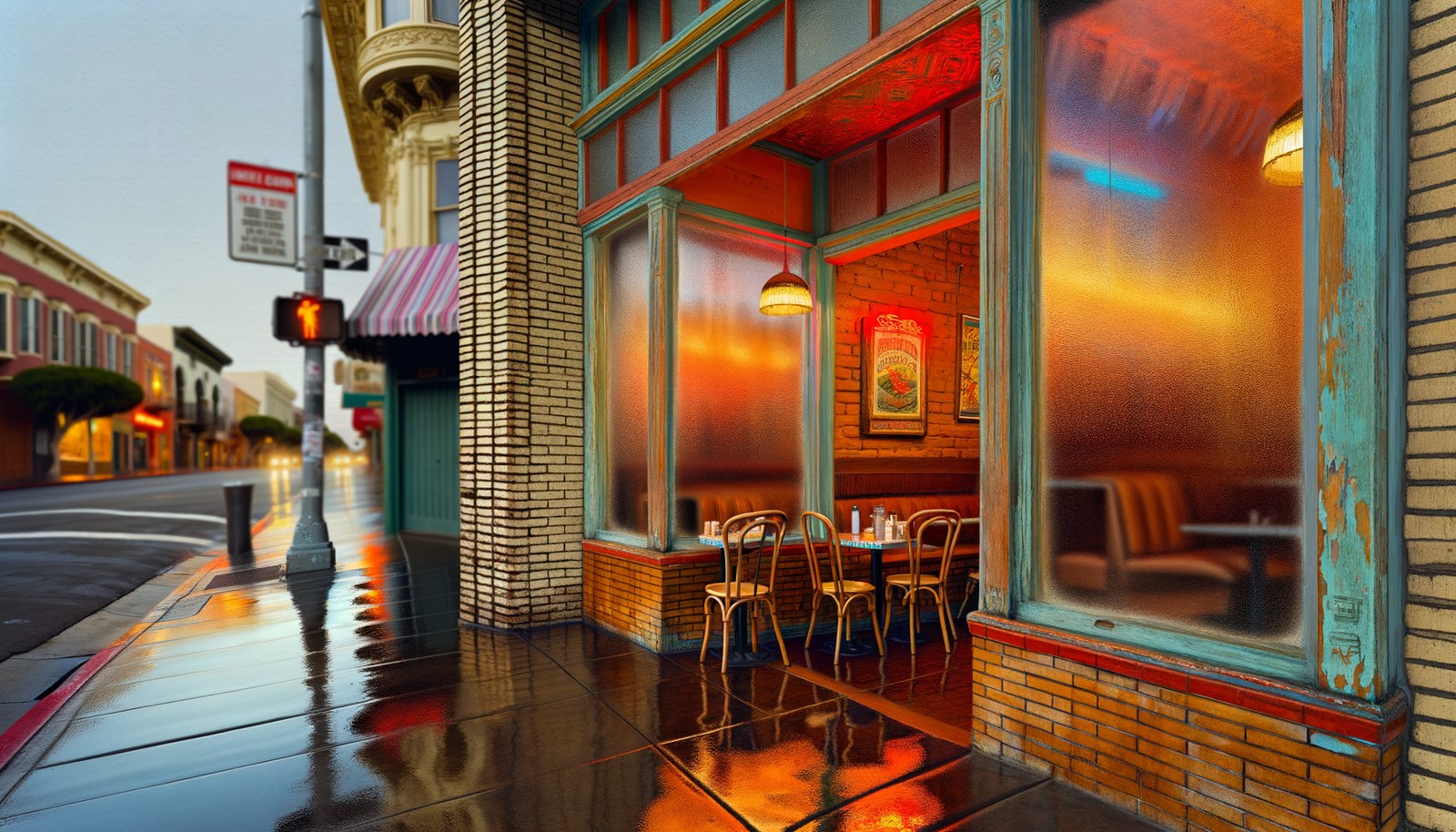
San Francisco · Mission
The Mission did not become a Mexican food neighborhood. It was built into one, block by block, from the 1960s through the 1990s, by families who opened on streets nobody was writing about.
The Block Before the Guide
The history of Mission District food in San Francisco does not start with a review. It starts with a lease. In the late 1950s and through the 1960s, Mexican and Central American families moved into the Mission in significant numbers, displacing an earlier Irish and Italian working-class population that had already begun drifting toward the Sunset and Daly City. The storefronts they opened on Mission Street, on 24th Street, and on the connecting blocks of Valencia Street were not aspirational. They were functional. A carnitas window that fed shift workers. A tamale counter that opened before dawn. A tortillería that sold masa by the pound to households that were not yet buying groceries from a supermarket.
The restaurants that followed — and by the 1970s there were enough of them to constitute an actual corridor — were not designed to be noticed. El Faro opened on Mission Street in 1961 and is credited, with some debate, as the place where the San Francisco-style burrito was first folded: a flour tortilla, steamed, wrapped tight around rice, beans, meat, and salsa, large enough to be a full meal for a laborer eating standing up. Whether or not the origin claim holds, the format held. The Mission burrito is a specific thing — not a Tex-Mex burrito, not a Chipotle burrito — and El Faro was making it before anyone had a name for it.
By the mid-1970s, the stretch of Mission Street between 24th and 25th became the gravitational center. La Taqueria. El Toro Taqueria. La Palma Mexicatessen. Three different registers of the same tradition: the sit-down taqueria, the fast counter, and the market-with-a-kitchen. All on or within a block of each other. All run by families whose names were not in any food guide and whose recipes were not written down anywhere except in the muscle memory of whoever was working the line.
What the 1980s Built
The Mission's food identity solidified in the 1980s not because the neighborhood became fashionable but because it stayed consistent while the rest of the city fluctuated. The dot-com wave had not arrived. Rents on Mission Street were still low enough that a family could open a taqueria without outside capital. The economics worked like this: low overhead, high volume, a menu of ten items, and a lunch rush from the warehouses and light-industrial operations that still occupied the flatlands south of 16th Street.
Pozole started appearing on more menus in this period — a slow-cooked hominy soup that takes most of a day to build correctly and does not fit the fast-counter model unless the kitchen is committed to making a large batch and selling it through. The restaurants that did it right, including Roosevelt Tamale Parlor on 24th, were operating from a different set of priorities than the burrito counters. The tamale parlor model — a full sit-down with mole, chile relleno, and a handmade corn dough program — was slower, lower-margin, and more technically demanding. Roosevelt had been at it since 1922. By the 1980s it was an institution that the neighborhood treated as background and tourists had not yet found.
The torta also expanded in this decade. Bread-based sandwiches — telera rolls, bolillo, the occasional French roll — carrying carnitas, milanesa, or beans and cheese became a midday staple that occupied a price point below the sit-down and above nothing. Pancho Villa Taqueria opened on 16th Street in 1987 and operated at a scale that smaller spots could not match: a line that ran out the door at noon and a menu that included every format. It became a reference point for the neighborhood's second generation of visitors — people who had not grown up in the Mission but were starting to eat there.
The 1990s and the Trompo
Al pastor arrived in the Mission in force in the 1990s. The technique — pork marinated in dried chiles and achiote, stacked on a vertical spit, shaved to order — had roots in Mexican adaptations of shawarma brought by Lebanese immigrants to Puebla in the early twentieth century. By the time it reached Mission Street, it had been in Mexican cooking for decades. What the 1990s Mission did was install the trompo as a permanent fixture in the taqueria window, visible from the street, a real-time signal of what was happening inside.
Taqueria Cancun. El Farolito. Taqueria El Buen Sabor. All three were running trompos by the mid-1990s, all three were open late, and all three were competing on a stretch of Mission Street where the margin between a good plate and a poor one was a matter of how long the pork had been on the spit and whether the pineapple was fresh. The algorithm notices this kind of incremental difference. The late-night walk-up crowd in 1994 noticed it too, even without a scoring system — they just voted with where they stood in line.
The birria question entered the Mission in this same period, though it did not dominate until later. Goat-based, brick-red, built on a dried-chile broth that takes overnight to develop correctly — birria was present on weekend menus at several spots but was not yet the city-wide conversation it would become. The 1990s Mission was still primarily a carnitas and al pastor neighborhood. The birria wave was forming elsewhere and would arrive later. The data on current menus reflects that trajectory clearly.
What the Data Shows Now
The current scoring pattern on Mission Street holds up what the historical record suggests: execution is the differentiator, not concept. The spots that have been open since the 1970s and 1980s do not score lower than the newer arrivals. In several cases they score higher, particularly on consistency — the measure of whether the fourth visit matches the first. A kitchen that has made the same carnitas burrito forty thousand times has a different relationship to the recipe than one that has made it four hundred times. The algorithm can see that difference in the data even when the menu descriptions are identical.
Value scores on Mission Street are uniformly high by San Francisco standards. A full plate — chile relleno, rice, beans, tortillas — at most of the established spots tracks under fourteen dollars at lunch. For context, that is roughly a third of what a comparable meal costs in Hayes Valley or the Financial District. ForkFox on Financial District dining makes this comparison explicit: the neighborhoods that have maintained working-class price points tend to score higher on value than neighborhoods that have repriced for tech-era income levels, regardless of execution quality.
The Mission also holds a structural distinction that the data keeps surfacing: the concentration of full-menu Mexican cooking — not just tacos and burritos, but mole, pozole, chile relleno, tamales — in a corridor where most spots have been operating the same menu for decades. The city's South Indian food scene in the Tenderloin follows a parallel pattern: an immigration wave in the 1970s and 1980s, a specific set of blocks, and a group of restaurants that have been cooking the same food for the same community for long enough that the cooking has depth. The best Mexican food in the Mission District San Francisco is not a new discovery. The numbers just confirm what the neighborhood already knew.
The cheesesteak is the line on the postcard. The Mission's al pastor is the whole page.
The restaurants that have been feeding the same block for fifty years are not doing anything new — they are doing the same thing correctly, which is harder.
We test dishes so you don't have to. No spam — just the best food, neighborhood by neighborhood.